


The future of collagen is plant-based: effectiveness, absorption, and sustainability
In recent years, collagen has taken on a central role in the fields of nutrition and cosmetics, thanks to its key contribution to the health of skin, joints, and connective tissues.
It is now well known that endogenous collagen production begins to decline as early as around age 18, with a progressive loss that intensifies with age: from the age of 40, the reduction rate is estimated at around 1% per year.
For this reason, interest has recently grown in alternative and sustainable sources of collagen capable of compensating for the physiological decline that occurs with age.
Different Types of Collagen
-
Type I Collagen - This is the most abundant protein in the human body, accounting for about 90% of total collagen. It forms strong fibers that create the structural framework of bones, skin, tendons, the cornea, and, more generally, connective tissue. Its structure is a triple helix formed by repeated sequences of glycine, proline, and hydroxyproline, with a molecular weight that can reach up to 300,000 Daltons. Bovine-derived Type I collagen is widely used due to its high biocompatibility, biodegradability, and low immunogenicity. However, about 3% of the population may develop allergic reactions to this type of collagen.
-
Type II Collagen - This is the main component of cartilage, a specialized type of connective tissue that coats and lubricates joint surfaces. It is primarily synthesized by chondrocytes from the amino acids lysine and proline. It is essential for maintaining joint elasticity and functionality.
-
Type III Collagen - This structural protein is mainly found in large hollow organs such as the uterus, intestines, and blood vessels. It often coexists with Type I collagen and contributes to the elasticity and integrity of soft tissues.
Hydrolyzed Collagen: Functional and Bioavailable Form
For collagen to be effectively absorbed and utilized by the body, it is often administered in hydrolyzed form, meaning it is broken down into medium and low molecular weight peptides (around 3 - 6 kDa). In this form, it is more easily absorbed in the intestines.
Several clinical studies have shown that a daily intake of 12 grams of hydrolyzed collagen can provide benefits for joints and cartilage, supporting bone health and reducing osteoarthritis symptoms. Regarding skin, the same dosage taken for at least 28 days has shown significant improvements in elasticity, hydration, and firmness.
Where Does Collagen Come From? A Comparison of Different Sources
Bovine Collagen
It is primarily extracted from various bovine connective tissues, particularly the Achilles tendons. This source is widely used due to its rich content of Type I collagen but presents some safety concerns - although greatly reduced today - regarding the risk of transmission of bovine spongiform encephalopathy (BSE), also known as "mad cow disease". Nevertheless, it remains one of the most traditional and commonly used sources in supplements.
Porcine Collagen
It is obtained by hydrolysis from pig skin through a thermal (hydrothermic) process. The resulting collagen has a molecular weight ranging from 3,000 to 5,000 kDa, making it suitable for high-bioavailability formulations. Porcine collagen is structurally similar to human collagen, with good biological compatibility and widespread use in medical and cosmetic applications.
Marine Collagen
Derived from the skin and entrails of various fish species - such as cod, tuna, or tilapia - through a controlled thermal hydrolysis process. Depending on the temperature and extraction conditions, peptides of varying molecular weights are obtained, generally up to 3,000 kDa. Marine collagen is especially valued for its purity, fast absorption, and low allergenic risk. It is also considered a more sustainable source compared to land animal sources.
Vegetable Collagen: An Innovative Form for Skin Health and Wellness
So-called "plant-based collagen" is not structurally identical to animal collagen but is obtained through biotechnological processes - such as fermentation - from plant sources like algae or plant cell walls. This innovative form, also known as fourth-generation collagen, has a low molecular weight peptide structure that promotes rapid absorption.
Studies on the VC-H1 peptide, for example, have shown that a daily intake of 1.5 g can improve skin elasticity and reduce wrinkle depth by stimulating fibroblasts and endogenous collagen production.
It is particularly suitable for those following vegan or vegetarian diets, as it contains no animal-derived ingredients, and for those seeking a sustainable and cruelty-free alternative in the nutrition and beauty sector.
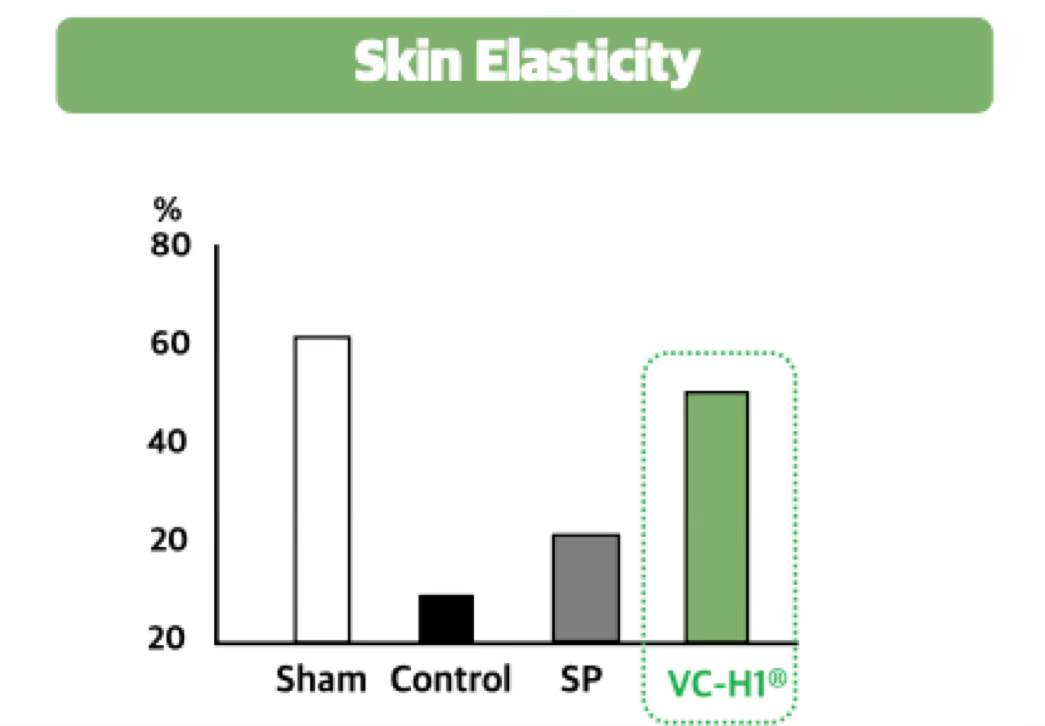
The graph shows how the intake of VC-H1®, a specific form of plant-based collagen, promotes a clear improvement in skin elasticity compared to control groups, confirming its effectiveness in supporting skin health.
Contact us for more information